
Choosing a cooling system based only on the installation quote can lead to higher costs over time. Lifecycle costing gives homeowners, landlords, builders, and business owners a clearer view of the total investment by comparing the purchase price, installation work, energy use, servicing, repairs, and expected system lifespan.
For businesses and property owners assessing Air Conditioning Installations, the lowest upfront price is not always the most cost-effective option. A system that is cheaper to install may use more electricity, require more maintenance, perform poorly in extreme heat, or need replacement sooner than a better-selected unit.
What Is Lifecycle Costing?
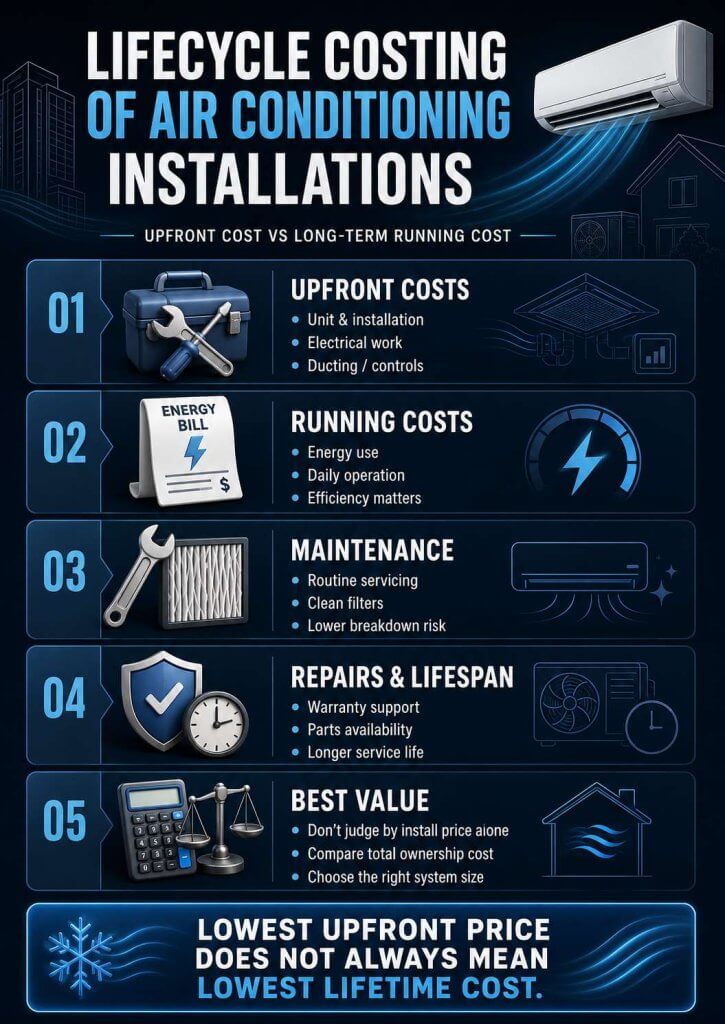
Lifecycle costing looks at the full cost of owning and operating an air conditioning system from installation through to replacement. It includes:
- Initial equipment purchase
- Labour and installation costs
- Electrical upgrades or switchboard work
- Ducting, zoning, pipework, and controls
- Energy consumption
- Scheduled servicing
- Repairs and parts replacement
- Warranty coverage
- System lifespan
- Replacement or disposal costs
This approach helps property owners compare systems based on long-term value, not just the first invoice.
Upfront Installation Costs
The installation cost usually includes the air conditioning unit, labour, materials, electrical work, refrigerant pipework, drainage, brackets, ducting, zoning components, and commissioning.
A split system may have a lower upfront cost because it serves one room or zone. A ducted system usually costs more to install because it requires ceiling space, ductwork, vents, zoning controls, and more planning. Commercial systems may involve additional compliance, access equipment, staged installation, and coordination with other trades.
However, upfront cost should be assessed against how the system will be used. A low-cost unit installed in the wrong location, undersized for the room, or poorly matched to insulation levels can cost more to run and may wear out faster.
Operational Costs Over Time
Electricity use is one of the largest long-term costs. In Western Australia, household electricity pricing is regulated by the State Government, and Synergy provides tools that help customers estimate how appliances contribute to their electricity bill.
Operational costs are affected by:
- System efficiency rating
- Correct sizing
- Usage hours
- Thermostat settings
- Insulation and window exposure
- Room size and ceiling height
- Zoning controls
- Filter condition
- Outdoor unit placement
- Maintenance frequency
A system that costs more upfront but uses less electricity may deliver lower total ownership costs over several years. This is especially relevant in Perth, where cooling demand can be high during summer.
Maintenance Costs
Maintenance is often overlooked during the buying stage. Filters, coils, drains, fans, electrical components, refrigerant levels, and controls all affect performance.
Regular servicing can help reduce running costs by keeping airflow clear and reducing strain on the system. Poor maintenance can increase energy use, reduce cooling output, create water leaks, and shorten the life of major components.
For commercial properties, maintenance can also affect staff comfort, tenant satisfaction, equipment rooms, customer areas, and business continuity. A planned servicing schedule is usually more cost-effective than waiting for breakdowns during peak summer demand.
Repair Costs and Warranty Value
Repair costs vary depending on the brand, system type, age, parts availability, and warranty terms. Cheaper systems may appear attractive at installation stage, but limited parts support or shorter warranty coverage can increase long-term risk.
When comparing quotes, property owners should consider:
- Manufacturer warranty
- Installer workmanship warranty
- Availability of spare parts
- Brand support in Australia
- Ease of servicing
- Access to indoor and outdoor units
- Complexity of controls or zoning
A system with strong local support may reduce downtime and repair delays. This is important for both homes and businesses relying on consistent indoor comfort.
Replacement Timing
Every system has a working lifespan. A well-installed and properly maintained system may last longer, while an undersized or poorly maintained system may need replacement earlier.
Replacement costs may include removing the old unit, upgrading electrical components, adapting pipework, replacing ducting, or improving controls. Lifecycle costing helps property owners plan for this instead of treating replacement as an unexpected expense.
Split System vs Ducted System Lifecycle Costs
A split system often suits single rooms, bedrooms, home offices, rental properties, and smaller spaces. It has a lower installation cost and can be efficient when used only where cooling is needed.
A ducted system suits whole-home comfort, larger homes, offices, and properties where multiple rooms require cooling. It costs more upfront but can offer centralised control, zoning, and a cleaner internal appearance.
The better choice depends on property size, usage habits, energy goals, and whether the owner wants room-by-room control or whole-property coverage.
Why Correct Sizing Matters
System sizing has a major impact on lifecycle cost. An undersized unit may run continuously, struggle to reach temperature, and wear out sooner. An oversized unit may cycle too often, reduce efficiency, and provide uneven comfort.
Correct sizing should account for:
- Floor area
- Ceiling height
- Insulation
- Window size and orientation
- Number of occupants
- Heat-producing appliances
- Room usage
- Local climate conditions
This is one of the most important reasons to use experienced installers rather than selecting a unit based only on price.
Commercial Lifecycle Cost Considerations
For commercial buildings, the cheapest installation can create higher operational risk. Poor system design may affect productivity, customer comfort, server rooms, stock protection, compliance obligations, and lease expectations.
Businesses comparing Air Conditioning Installations should consider energy use, access for maintenance, service response times, zoning, after-hours operation, and future expansion. A system that supports the building’s actual operating pattern is usually more cost-effective than a basic installation designed only to reduce initial spend.
Perth Climate and Energy Use
When assessing Air conditioning Perth, property owners should consider the impact of long summer operating hours. Systems used heavily during hot weather need reliable installation, correct airflow, clean filters, and efficient performance.
Energy efficiency becomes more important when cooling is used daily. A well-designed system may cost more at the start but can reduce electricity use, maintenance pressure, and replacement risk over the system’s life.
How to Compare Quotes Properly
A useful quote comparison should go beyond the final price. Property owners should ask what is included, what is excluded, which brand and model is supplied, how the system is sized, what warranty applies, and how maintenance access is handled.
A lower quote may not include electrical upgrades, drainage solutions, proper mounting, zoning, commissioning, or after-installation support. These omissions can create additional costs later.
Practical Lifecycle Cost Example
A cheaper system may save money on installation day but cost more through higher energy use, more frequent repairs, reduced comfort, and earlier replacement.
A better-selected system may have a higher upfront cost but deliver:
- Lower running costs
- More consistent cooling
- Better airflow
- Longer service life
- Reduced breakdown risk
- Stronger warranty support
- Easier maintenance access
This is why lifecycle costing is a more reliable way to compare options.
Conclusion
Lifecycle costing helps property owners make better decisions by looking at the full cost of installation, operation, maintenance, repair, and replacement. The right system is not always the cheapest system. It is the one that fits the property, usage needs, energy expectations, and long-term budget.
For homes, rentals, offices, and commercial properties comparing Air conditioning Perth, lifecycle costing provides a practical framework for selecting a system that supports comfort, efficiency, and long-term value.